8 min read
Every one of our Murano glass clowns begins with molten glass and the coordinated work of skilled glassmakers. Before the familiar face, colorful clothes and playful expression appear, the material passes through a sequence of hot-working stages in which timing, temperature and manual control determine the final result.
A clown is an especially interesting subject because it combines sculpture, color and character in a single object. The body must have the right proportions, the head must match its pose, and small additions such as hands, shoes, buttons, hats or accessories have to be applied while the glass remains workable.
This is how a Murano glass clown takes shape, from the preparation of the glass to the gradual cooling of the finished piece.
Contents
- From raw materials to molten glass
- Blown or solid glass: choosing how to build the clown
- Working as a team at the furnace
- Shaping the body while the glass is hot
- Creating the head and facial expression
- Joining the different parts of the clown
- Watch a Murano glass clown being made
- Why timing is essential in handmade glassmaking
- Annealing and gradual cooling
- Why every handmade clown is slightly different
- From the furnace to the finished collection
- Frequently asked questions
- Discover Murano glass craftsmanship up close
From raw materials to molten glass
The process begins before the clown itself exists.
In traditional furnace terminology, the preparation of the glass batch is sometimes referred to as the “partia.” A composition based on silica sand and soda, together with the other ingredients required for the glass, is prepared and melted at extremely high temperatures.
The furnace transforms these raw materials into a homogeneous mass of molten glass that can be gathered and worked by the glassmakers. Temperatures can reach around 1,400°C, or approximately 2,550°F, during the melting process.
At this stage, the material that will eventually become a face, a jacket, a shoe or an entire body has no defined shape. The glassmaker’s task is to control that fluid material through heat, movement and a series of traditional hand tools.
This relationship between temperature and timing continues throughout the entire process. Glass that is too hot can lose the intended shape; once it cools too far, it becomes increasingly difficult to model.
To learn more about what happens inside a Murano glass furnace and how handmade workmanship contributes to the value and authenticity of Murano glass, explore our dedicated guide.
Blown or solid glass: choosing how to build the clown
There is no single construction method for every Murano glass clown.
Depending on the size, proportions and design of the finished object, different sections can be created using blown glass or solid hot-worked glass.
Blowing allows the glassmaker to introduce air into the molten glass through a blowpipe, creating volume while controlling the thickness and shape of the piece. Solid glass, on the other hand, offers a different kind of mass and is particularly suitable for details or forms that need greater visual and physical weight.
The choice depends on the clown being produced.
A small figure and a large composition with several accessories present very different technical challenges. The glassmaker must understand from the beginning how much glass will be required and how the individual sections will eventually be joined.
This is one reason the finished sculpture should be understood as the result of a sequence rather than a single gesture.
Working as a team at the furnace
Creating a complex figurative object requires coordination.
In the traditional process used for our clowns, several people can participate in the production of a single piece. Some concentrate on the head and facial elements, while others work on the body and its decorative details.
Each glassmaker has to follow the rhythm of the others.
A component cannot simply be produced and left aside indefinitely. The different sections have to reach the correct temperature and consistency at the right time so they can eventually be assembled.
The team works around the furnace, reheating individual elements whenever necessary and continuously evaluating the behavior of the material.
This makes the creation of a glass clown quite different from assembling an object from prefabricated parts. The sculpture develops while the glass is alive, hot and constantly changing.
For centuries, the furnace has been the place where Murano glassmaking skills, techniques and working rhythms have developed. Our article on Murano furnaces and the Venetian glassmaking tradition explores this historical and artisanal context in greater detail.
Shaping the body while the glass is hot
Once the required amount of molten glass has been gathered, the body begins to acquire its basic volume.
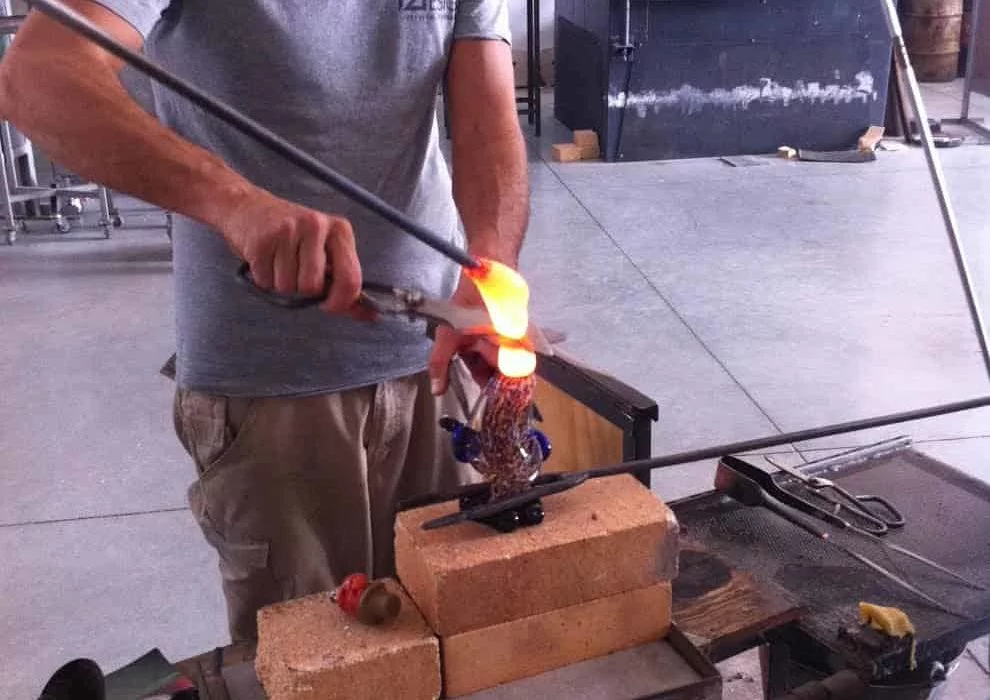
The glassmaker rotates and works the material to keep it centered before shaping it according to the particular clown being produced. Traditional tools, including metal pincers and shears, are then used to pull, compress, cut and define specific areas.
Much of this work takes place while the master glassmaker is seated at the traditional glassmaking bench, known in Venetian workshop terminology as the “scanio.”
The bench gives the glassmaker a stable working position while the rod or blowpipe is continuously rotated.
This movement is essential because gravity never stops acting on hot glass. Keeping the object turning helps maintain control over the distribution of the material while the glassmaker shapes the body.
Color is incorporated as part of the design. Different clowns may feature bold jackets, contrasting trousers, striped surfaces, transparent sections or decorative applications.
The overall silhouette starts to become recognizable, but many of the details that create the character are still missing.
Creating the head and facial expression
The face is one of the most distinctive stages in the creation of a Murano glass clown.
A few small changes in the position of the mouth, nose, eyes or hat can completely alter the expression of the figure. This means that even when the same model is produced several times, the manual process naturally introduces subtle differences.
The glassmaker first establishes the basic volume of the head and then gradually adds the individual features.
Small quantities of hot glass can be applied to form facial elements or decorative details. Each addition must bond correctly with the underlying glass while still allowing the artisan to control its position.
The head also has to remain proportional to the body that is being produced by the rest of the team.
At this point, technical precision and visual judgment become closely connected. The glassmaker is working with dimensions, temperature and balance, but also with personality.
That expression is one of the reasons these figures became such recognizable objects within Venetian artistic glass. For readers interested in their origins, vintage examples and collectible characteristics, we explore those subjects separately in our guide to Murano glass clowns: art, history and collectible value.
Joining the different parts of the clown
Once the main components are ready, one of the most delicate moments begins: bringing them together.
The body and head have been created through separate operations, but they now need to become a single sculpture. Their temperatures must be carefully managed so that the glass can be joined without compromising the forms already created.
The master glassmaker positions the head and connects it to the body while the material is still hot enough to bond.
Additional elements can then complete the composition. Depending on the model, these may include arms, hands, shoes, buttons, a hat or the objects that define a specific scene.
A musician, an acrobat, a clown holding balloons and a figure riding a Vespa all require different solutions.
The underlying principles of hot glassmaking remain the same, but the sequence of operations changes according to the sculpture.
Watch a Murano glass clown being made
The manual nature of the process becomes much clearer when seen in motion.
In this video, you can observe one of the key stages in the making of a Murano glass clown: the glassmaker works on the head, connects it to the body and prepares the sculpture for the next phase of the production process.
Watching the process also reveals something that photographs cannot fully communicate: the continuous movement required to work hot glass.
The piece is constantly rotated, repositioned and reheated. The glassmaker has only a limited working window before the material begins to stiffen and another visit to the furnace becomes necessary.
Why timing is essential in handmade glassmaking
Glass changes continuously as its temperature falls.
When it leaves the heat, it is soft enough to stretch, compress or reshape. As it cools, it becomes progressively firmer. The artisan therefore needs to recognize exactly when the material is ready for a particular operation.
Some adjustments require softer glass. Others become easier once the shape has gained enough stability to resist deformation.
This creates a working rhythm based on repeated cycles of heating, shaping, checking and reheating.
Experience allows the glassmaker to read the material through visual cues, movement and resistance. Decisions often need to be made within seconds.
The finished clown may appear playful and spontaneous, but achieving that effect requires considerable control over a material whose behavior changes throughout the process.
Annealing and gradual cooling
Finishing the shape does not mean that the production process is complete.
A freshly made glass sculpture cannot simply be left to cool rapidly at room temperature. Different parts of a complex object may retain heat differently, creating internal stresses that could eventually damage the piece.
For this reason, the completed clown is placed in an annealing kiln.
In the traditional production process, the kiln is kept at approximately 500°C, or 930°F, while the day’s pieces are being produced. The temperature is then reduced gradually so that the glass can cool in a controlled way.
This phase is much quieter than the work at the furnace, but it is essential to the stability of the finished sculpture.
Only after the cooling cycle has been completed can the clown be handled as a finished object.
Why every handmade clown is slightly different
Two handmade Murano glass clowns based on the same design will never be perfectly identical.
This does not come from a deliberate attempt to introduce random variation. It is a direct consequence of working the material by hand.
A slight difference in the amount of glass gathered, the pressure of a tool, the position of an applied detail or the timing of a movement can influence the final form.
Facial expressions are particularly revealing. The curve of a mouth, the shape of a nose or the angle of a hat can subtly change the character of the figure.
Color distribution can vary as well, especially in decorative sections created directly while the glass is hot.
These variations document the making process itself. They are visible evidence that the object was shaped individually rather than reproduced through a fully automated industrial process.
From the furnace to the finished collection
Once the piece has completed its annealing cycle, the technical process gives way to the finished object: a colorful character whose appearance often hides the complexity involved in making it.
The Vetreria Murano Design collection includes classic clowns as well as musicians, acrobats, figures with balloons, gondolas, cars, boats and other compositions. Each design asks the glassmakers to solve a different combination of proportions, applied elements and decorative details.
The result can be appreciated as an example of glassmaking craftsmanship, as a collectible figure or simply as an expressive object.
Its decorative role is a subject in itself. For ideas on placement, color combinations and the relationship between these sculptures and contemporary spaces, read our guide to Murano glass clowns in interior design.
For those who want to see the different subjects and variations produced by Vetreria Murano Design, the complete Murano glass clown collection brings together everything from traditional figures to more elaborate scenes.
Frequently asked questions
Are Murano glass clowns blown by hand?
Murano glass clowns can combine different techniques depending on the model, dimensions and individual parts of the sculpture. Some volumes can be created with blown glass, while other sections and decorative elements are shaped from solid hot glass. Much of the character of the final piece comes from manual hot-working and the application of individual details.
How long does it take to make a Murano glass clown?
Production time varies considerably according to the size and complexity of the model. A simple figure requires fewer operations than a large clown featuring several accessories or a scene composed of multiple elements. The process also includes annealing and gradual cooling after the hot-working stage has been completed.
Why are two handmade Murano glass clowns different?
Because each figure is shaped manually while the glass is hot. Small differences in movement, proportions, color distribution and applied details naturally occur during production. These variations are part of the handmade character of the sculpture.
Why does a glass clown have to cool slowly?
Controlled cooling reduces the internal stresses that can develop when different areas of a glass object change temperature at different rates. The finished clown is therefore placed in an annealing kiln and cooled gradually before it can be handled as a completed piece.
Discover Murano glass craftsmanship up close
The finished clown captures only the last moment of a much longer process. Behind its colors and expression are molten glass, repeated heating, hand tools, coordinated teamwork and decisions made while the material is constantly changing.
At Vetreria Murano Design, this knowledge is applied to a wide range of clown models and compositions, from recognizable traditional figures to more complex subjects designed for collections, retailers and special projects.
Explore our Murano glass clown collection or contact us to learn more about our creations and production possibilities.